SD raid on the Nippon Times Building
The SD raid on the Nippon Times Building is the violent climax of the novel's espionage plot, the moment when the long-simmering conflict between the German Sicherheitsdienst and the Japanese Trade Mission erupts into open gunfire. It is the event that transforms Nobusuke Tagomi from a bureaucratic official into a killer, shattering his Buddhist worldview and precipitating the spiritual crisis and physical collapse that define his final chapters. The raid also marks the failure of the SD's attempt to capture Rudolf Wegener, the Abwehr captain who has come to San Francisco to warn the Japanese of Operation Dandelion, and it seals the fate of Frank Frink, whose arrest for the fake admiral incident is set in motion by the same day's events.
Background and the Gathering Storm
The raid is the culmination of a week of escalating tension. Wegener, traveling under the cover name Baynes, has been waiting in San Francisco for the arrival of General Tedeki, the elderly Japanese military figure who is to receive his intelligence about Operation Dandelion, a planned nuclear attack on the Home Islands. The death of Chancellor Martin Bormann has thrown the Reich into political chaos, and the SD, under the local chief Bruno Kreuz vom Meere, has been tracking Wegener since he made contact with an Abwehr agent at the Fuga Department Store. Kreuz vom Meere, having obtained authorization from Consul Hugo Reiss and even a personal call from the new Chancellor, Doctor Goebbels, has prepared a Kommando squad to seize Wegener. The SD men, described as looking like "violinists" or "divinity students," are ready to move, and the raid on the Nippon Times Building is their chosen moment of attack.
The Assault and the Shootout
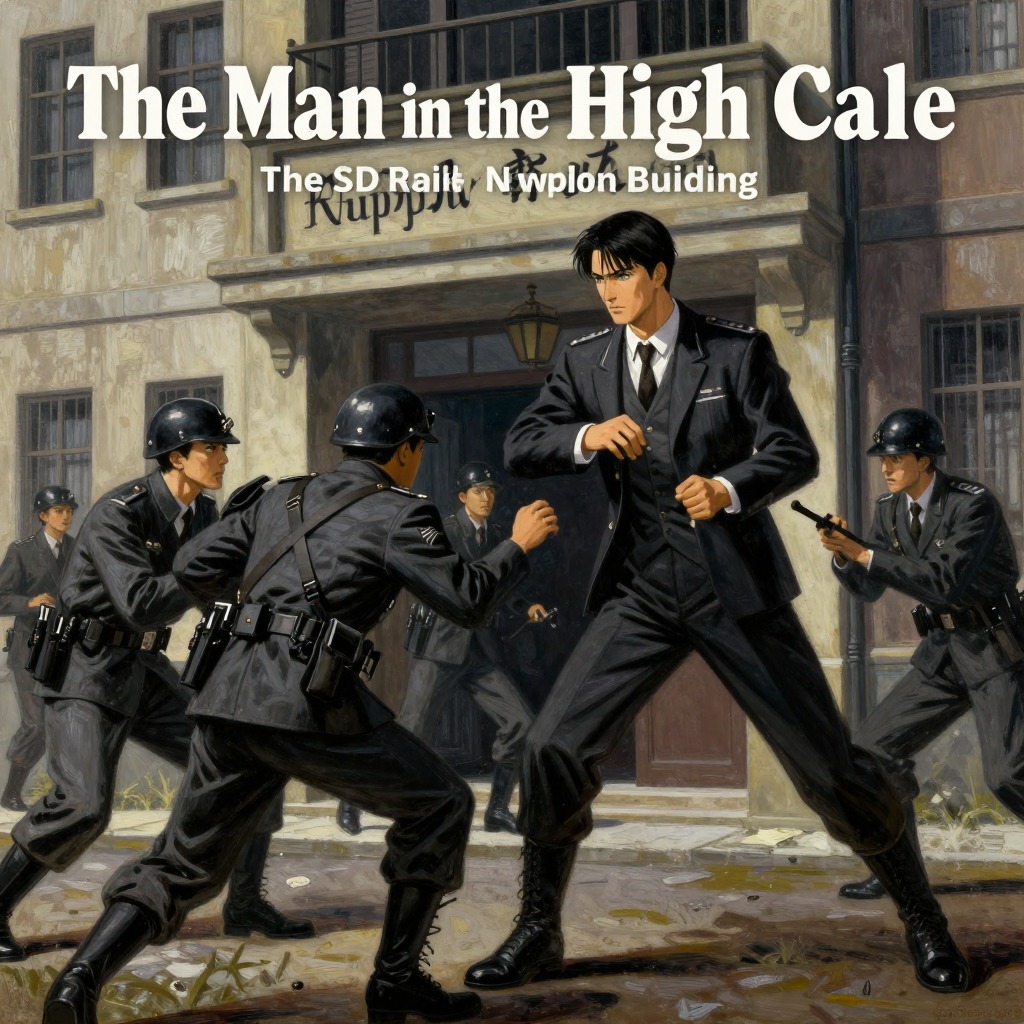
The SD men, two burly whites armed with silenced pistols, burst into Tagomi's office on the twentieth floor of the Nippon Times Building, where Wegener and General Tedeki are meeting. They spot Wegener and move to seize him, but Tagomi, who has been holding his treasured Colt .44 revolver, opens fire. He shoots one SD man, who falls to the floor, and then, with "record-eclipsing speed," fans the hammer of the single-action revolver, firing again and again. The second SD man's jaw bursts, sending "bits of bone, flesh, shreds of tooth" flying into the air. Tagomi, horrified by the carnage, reloads his antique weapon while Wegener and General Tedeki pick up the silenced pistols of the fallen men. The raid is repelled, but the psychological damage to Tagomi is immediate and profound.
Consequences and Aftermath
The immediate aftermath is a standoff. Tagomi, Wegener, and General Tedeki barricade themselves in the office, with Tagomi declaring they will "mow them down" if more SD men appear. The Nippon Times employees, armed with riot equipment, eventually arrive, and the SD men are found dead or dying. Wegener, examining the scene, notes that the pistols are Japanese-made and that the dead man is a PSA citizen named Jack Sanders, with no connection to the SD, a detail that suggests the SD will deny any involvement. The raid has failed, but it has exposed the meeting and confirmed the SD's knowledge of Wegener's mission. General Tedeki, having placed a call to Tokyo, is able to arrange for military relief, but the damage is done.
Tagomi's Spiritual Crisis
For Tagomi, the raid is a catastrophe of the soul. He has killed two men, an act that violates his Buddhist upbringing, which holds that no life is to be taken. He is described as being in a state of "despair," unable to comprehend the moral ambiguity of his actions. General Tedeki observes that Tagomi, "raised as a Buddhist," has no standpoint by which to view and comprehend his act, and that he may retreat into mental illness or, with time, recover his equilibrium. Wegener reflects that Tagomi's dilemma is the same one they all face: the need to commit acts of violence or evil in a world where clear moral alternatives are absent. The raid thus becomes the catalyst for Tagomi's subsequent breakdown, his wandering through San Francisco, his encounter with the Edfrank silver triangle, and his eventual heart attack, which occurs as he confronts Consul Reiss over the fate of Frank Frink.
Narrative Significance and Thematic Resonance
The raid is a turning point in the novel's exploration of violence and morality. It is the only scene in which a major character directly kills another, and it forces Tagomi to confront the reality of the Nazi evil he has only heard about. The event also underscores the novel's central theme of the impossibility of moral clarity in a world ruled by totalitarian powers. Tagomi's act of violence, committed to save Wegener and the mission, is simultaneously a violation of his deepest beliefs, and the novel offers no easy resolution to this paradox. The raid also serves to connect the various plotlines: it is the event that leads to Tagomi's release of Frank Frink, who has been arrested for the fake admiral incident, and it marks the end of Wegener's mission in San Francisco, as he is forced to return to Berlin, where he will face the SD again. The raid, in its sudden violence and its lasting consequences, is the novel's most dramatic demonstration of the cost of resistance in a world where even the righteous are forced to become killers.